
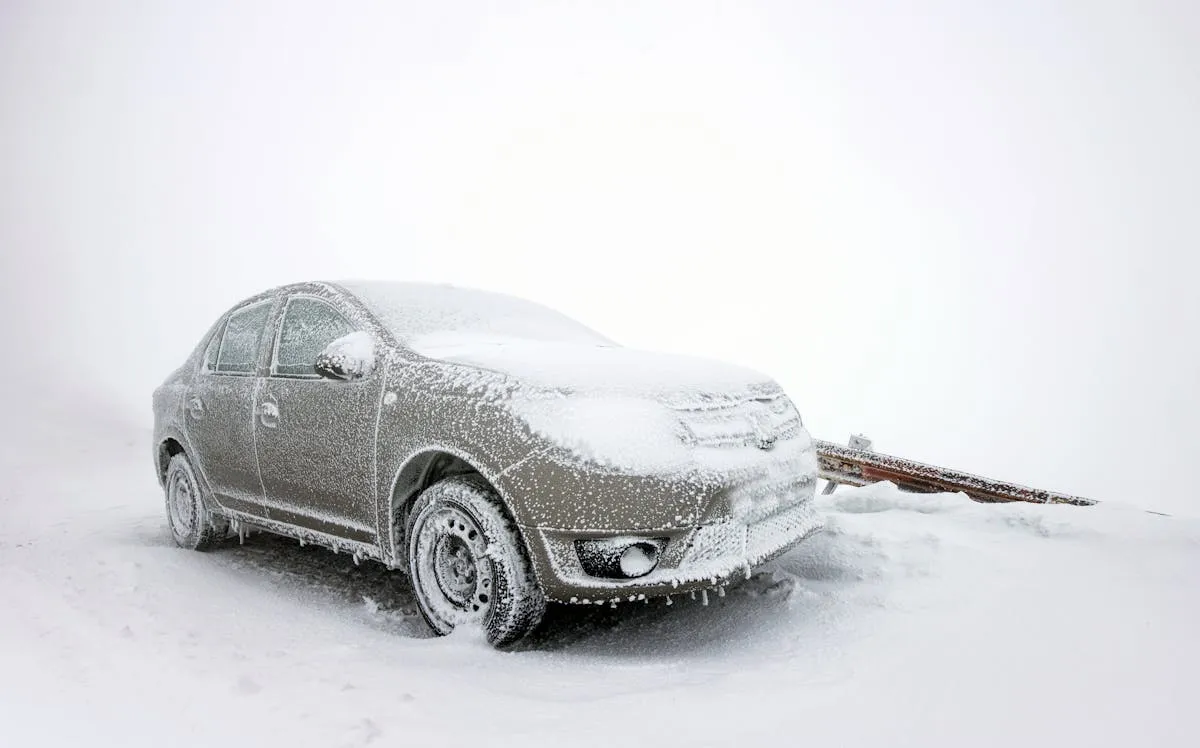
The photo is a general winter illustration; it does not show a chain installation or a tested AWD vehicle.
This guide covers passenger cars and light SUVs without trailers. Towing and heavier or commercial vehicles have additional requirements. The rules below were checked November 3, 2026; check the road again before traveling.
What R1, R2 and R3 mean for an AWD car
Caltrans treats AWD like four-wheel drive for chain control. Its chain-control guidance and detailed requirements describe the following conditions. “Chains” here includes suitable tire traction devices, such as permitted cables, that fit your vehicle.
| Control | When this vehicle can remain unchained | What to carry |
|---|---|---|
| R1 | A passenger vehicle or light truck under 6,000 pounds gross weight, with qualifying snow tires on at least two drive wheels and no trailer. | Suitable devices for one drive axle. |
| R2 | An AWD or 4WD vehicle under 6,500 pounds gross weight, with qualifying snow tires on all four wheels and no trailer. Have the drive system engaged. | Suitable devices for one drive axle. |
| R3 | No exception: install the required devices even with AWD and snow tires. | Suitable devices, installed as directed. |
The weight limits are gross weight, not a blanket exemption for every SUV or EV. If you are unsure how the limit applies to your vehicle, check with Caltrans before the trip. Yosemite National Park’s explanation also specifies an engaged drive system and the no-trailer condition. If you are towing, consult the detailed requirements: both the vehicle and trailer may need devices.
The one-axle set shown is the minimum carry requirement described by Caltrans for an exempt AWD vehicle. Check your vehicle manual and carry any additional devices it requires for your configuration.
Follow the posted signs and instructions from Caltrans or California Highway Patrol personnel, even if a traffic report says something different. Controls can change quickly, and a road may close before R3 is imposed. Carrying devices does not give you permission to pass a closure.
Check the sidewall and tread
For the snow-tire exception, Caltrans identifies tires marked M+S, M-S, M/S or Mud and Snow and requires at least 6/32 inch of tread depth. Check every tire that must qualify for the control level. A marking on a worn tire is not enough, and a tire’s marketing name alone does not establish that it qualifies.
Passing the chain-control test does not make all qualifying tires equivalent in winter conditions. For the larger choice between tire types, see our guide to all-season, all-weather and winter tires. Whichever tires you choose, carry the required devices into a control area.
Find a device that fits your actual car
Before buying or packing chains, check the owner’s manual for your year, model and configuration, then compare its instructions with the actual tire size on the sidewall. Check which axle and device type the vehicle allows, and match the device manufacturer’s fitment information to that tire. Changed wheels or tires can change the fitment question; don’t assume a device selected for the factory size still fits.
Restrictions vary. For example, the current Tesla Model Y owner’s manual specifies rear-tire installation and different approved chains for certain configurations. Those instructions are specific to that vehicle, not a rule for all AWD cars. Consult the manual for your own car and resolve any conflicting fitment instructions with the vehicle or device manufacturer before leaving.
Some vehicles cannot accommodate conventional link chains but may accept another traction device. A vehicle manufacturer’s chain restriction does not waive the control-area requirement. If you cannot find a permitted, suitable device, change the trip plan rather than enter the controlled road without one.
Before you leave and at the checkpoint
Check Caltrans QuickMap for chain controls and closures along the route, and check a current forecast for the pass and destination. Caltrans also provides road conditions by highway and a phone line at 800-427-7623. Conditions can change after you leave, so recheck when it is safe to do so. For roads inside Yosemite, the park lists a separate conditions number: 209-372-0200, then 1, 1.
Learn the installation and removal instructions before the trip. Pack the correctly sized devices where you can reach them, along with gloves and warm clothing. Check tires, wipers and lights before departure; our fall car-care checklist covers those checks in more detail.
When signs or officials require installation, pull completely off the roadway into a suitable turnout. Never stop in a traffic lane to put devices on. Caltrans says the speed limit when chains are required is 25 or 30 mph; Yosemite specifies 25 mph in its chain-control areas even if another sign shows a higher limit. Follow the applicable limit and any lower vehicle or device limit, and slow further for conditions. After the end-of-control sign, use a safe pull-off to remove them when conditions and the instructions allow.